The global textile industry faces growing pressure to reduce its environmental footprint. From manufacturing to disposal, every stage of a garment’s life consumes resources and generates waste. Governments, consumers, and industry bodies are calling for greater transparency, accountability, and circularity.
RFID technology is emerging as a practical tool to support these goals. By providing accurate, real-time data on the location, condition, and history of textile items, RFID enables businesses to reduce waste, extend product life, and build more sustainable operations.
The Sustainability Challenge in Textiles

The textile sector remains one of the most resource-intensive industries worldwide. Each year, vast quantities of clothing, linens, and other textiles reach the end of their useful life and end up in landfills or incinerators. Much of this waste stems from overproduction, inefficient inventory management, and a lack of visibility into what is actually in circulation.
Traditional tracking methods such as barcodes, manual logs, and spreadsheets cannot provide the granular, real-time data needed to manage textiles sustainably. Businesses often order more than they need because they do not know what they already have. Items are lost or discarded prematurely. And without accurate lifecycle data, replacement decisions are based on guesswork rather than fact.
How RFID Supports Sustainable Practices
RFID tags give every textile item a unique digital identity that can be read automatically throughout its lifecycle. This identity stays with the item from the moment it is manufactured to the point of recycling or responsible disposal.
The technology generates a continuous stream of data that helps businesses make better decisions at every stage.
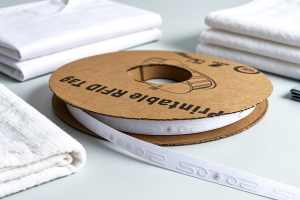
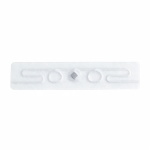
Manufacturing. RFID tags embedded during production allow manufacturers to track raw materials and finished goods more efficiently. This reduces overproduction and waste. Increasingly, tags are being integrated during standard label manufacturing, eliminating separate tagging steps and reducing labor.
Logistics and distribution. Real-time tracking during transportation reduces losses and damage. When items are continuously monitored, fewer are lost or misrouted.
Rental and service operations. For textile rental companies and industrial laundries, RFID enables automated sorting, real-time inventory tracking, and accurate billing. This reduces labor costs and ensures that items are used efficiently throughout their service life.
Hospitality and healthcare. Hotels and hospitals manage thousands of linens, uniforms, and gowns that must be tracked and maintained to high standards. RFID helps prevent loss, ensures proper washing and handling, and extends the useful life of these items.
End-of-life and recycling. At recycling facilities, RFID enables automated sorting that achieves high accuracy in identifying item materials. This supports efficient material recovery and reduces contamination in recycling streams.
Reducing Waste Through Better Data
One of the most significant contributions of RFID to sustainability is waste reduction. When businesses know exactly what they have and where it is, they can make smarter decisions about ordering, maintenance, and replacement.
Accurate lifecycle data allows managers to identify which items wear out faster and adjust purchasing accordingly. Instead of ordering excess inventory to hedge against unknown losses, they order only what is needed. This reduces both procurement costs and waste.
When textiles are properly maintained and replaced at the right time, they last longer. Every additional wash cycle extends the life of the item and delays its entry into the waste stream.
Supporting Compliance and Transparency
Regulations are evolving to require greater accountability in textile production and disposal. The European Union’s Ecodesign for Sustainable Products Regulation (ESPR) and Digital Product Passport (DPP) requirements are pushing the industry toward greater traceability.
RFID provides the data infrastructure needed to meet these requirements. A Digital Product Passport requires detailed information about an item’s materials, origin, and lifecycle. RFID can capture and store this data automatically, making compliance more manageable.
For businesses selling into regulated markets, the ability to demonstrate traceability is becoming a competitive advantage.
The Business Case for Sustainable RFID Adoption
Sustainability and profitability are not in conflict. RFID helps businesses reduce costs while improving their environmental performance.
Lower procurement costs: Accurate inventory data means less overordering.
Reduced losses: Tracking every item reduces shrinkage.
Extended asset life: Data-driven maintenance and replacement decisions keep items in use longer.
Improved efficiency: Automated tracking reduces labor costs and errors.
Regulatory readiness: Traceability data supports compliance with evolving regulations.
These benefits are measurable and often materialize within the first year of deployment.
The Path Forward
The textile industry is undergoing a transformation. Regulatory pressure is increasing. Consumer expectations are rising. The environmental case for change is compelling.
RFID technology offers a proven path toward more sustainable textile management. It provides the visibility and data needed to reduce waste, extend product life, and support circular business models.
For businesses ready to embrace this shift, the technology is available, mature, and scalable. The question is not whether RFID will play a role in sustainable textile management—it already does. The question is how quickly the industry will adopt it at scale.