Running an industrial laundry is a logistics challenge on a massive scale. Thousands of items—uniforms, sheets, towels, gowns, and mats—move constantly through the system: incoming from customers, into washing tunnels, through sorting lines, out to finishing, and back to delivery trucks.
At every step, there is room for error. Items get miscounted. Garments go missing. Sorting consumes hours of labor. And when the final invoice is sent, disputes arise because nobody can prove exactly what was shipped.
For decades, industrial laundries have relied on manual counting, barcodes, or paper records to manage inventory. These methods are slow, error-prone, and simply cannot keep up with the volume and speed of modern laundry operations. But RFID technology is changing that.
The Real Costs of Running Without RFID
Industrial laundries that rely on traditional tracking methods face a familiar set of problems.
Shrinkage is a constant drain. Industry data shows that uniform and textile rental providers typically experience loss rates of 10 to 15 percent of their inventory. Garments go missing in transit, get misdelivered to the wrong customer, or are simply never returned. Every lost item means a replacement cost and a strained customer relationship.
Sorting is a labor bottleneck. Manually sorting garments by customer, type, or wash program typically requires two to eight operators per shift. It’s physically demanding, tedious, and hard to scale. As volumes grow, the sorting line becomes a bottleneck that slows down the entire operation.
Inventory is a guessing game. Without real-time visibility, managers don’t know exactly what’s on hand. So they overstock to hedge against loss—tying up capital and increasing waste. Or they run short and disappoint customers.
Billing is a source of disputes. Invoices are based on estimates rather than item-level data. Customers question the charges. Providers absorb costs or enter lengthy disputes. Trust erodes.
How RFID Changes the Equation
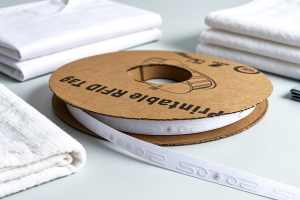
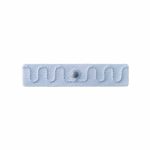
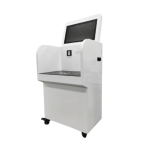
RFID laundry tags—small, durable chips sewn or heat-sealed into each textile—give every item a unique digital identity. Fixed readers at key points throughout the laundry—intake, washing, sorting, finishing, storage, and dispatch—automatically capture data from every tag as items pass through.
No line-of-sight required. No manual scanning. No human error.
The result is a continuous, real-time flow of data that transforms every aspect of laundry operations

What RFID Delivers for Industrial Laundries
1. Loss rates drop dramatically
RFID tracking cuts typical loss rates from 10–15% to under 3%. When every garment has a digital footprint, misplaced items are far easier to locate. The system records exactly where and when each item was last scanned. If something goes missing, there’s a clear audit trail. Providers can investigate, recover items, and hold customers accountable when necessary.
2. Sorting labor is slashed
Automated sorting replaces manual labor. RFID readers identify each item instantly and direct it to the appropriate cart, conveyor, or washing machine. Instead of two to eight operators per shift, laundries can operate with one to two people moving materials through the production line. The reduction in labor costs alone often justifies the investment.
3. Inventory visibility is instant and accurate
Traditional manual inventory counts can take hours. With RFID, managers see real-time inventory levels at a glance. Fixed readers in storage areas continuously track what’s on hand. No more guessing. No more overordering. No more stockouts.
4. Wash cycle data enables smarter replacement
Every wash cycle is automatically recorded. Over time, the system builds a complete lifecycle history for each item. Managers know exactly how many times a garment has been washed and when it’s approaching the end of its useful life. Replacement decisions are based on data, not guesswork. This extends the average life of textiles and reduces capital expenditure.
5. Billing accuracy eliminates disputes
Item-level tracking means invoices are based on verified data, not estimates. Customers see exactly what they received and what they returned. Disputes decrease. Trust increases. And providers get paid accurately for the services they deliver.
6. Traceability supports compliance
In regulated industries like healthcare and food processing, knowing which garments were worn by whom and when is critical. RFID provides per-wearer traceability and audit-ready records. This helps laundries meet hygiene and safety standards without adding administrative overhead
A Proven Technology at Scale
RFID laundry tracking is not experimental. It has been deployed in thousands of industrial laundries worldwide.
A European laundry group, Bulle de Linge, uses RFID-enabled sorting carts to track textiles for nursing home customers across France, Belgium, Spain, and Switzerland. The system detects when personal garments are accidentally mixed with linens, preventing losses that were previously a frequent complaint.
In Spain, industrial laundry Interhospitalia implemented an RFID-based automated sorting system that processes up to 1,800 items per hour—equivalent to the work of two operators per shift. The system handles linens contaminated with blood and other hospital residues, eliminating the need for workers to manually sort hazardous materials.
A European textile rental company integrated RFID tags into 200,000 items of towel and uniform inventory, achieving 99.5% inventory accuracy and a 70% reduction in labor costs for sorting.
These are not isolated experiments. They are real-world deployments delivering measurable returns.
What This Means for Your Laundry
If your industrial laundry is still counting textiles by hand, sorting garments manually, and guessing at inventory levels, the gap between where you are and where you could be is widening every day.
RFID technology is mature. The tags survive hundreds of industrial wash cycles. The readers are reliable. The software is accessible. And the return on investment is measurable—often within the first year of operation.
The question isn’t whether RFID will become the standard for industrial laundry tracking. It’s whether your operation will be ready when it does.