Uniform rental is a business of constant movement. Garments go out to customers, come back for cleaning, get sorted, and go out again. Day after day, week after week, thousands of items circulate through the system.
And somewhere along the way, a percentage of them disappear.
For uniform rental providers, this is not a minor inconvenience. Lost uniforms mean replacement costs, billing disputes with customers, and the constant pressure to keep inventory levels high enough to meet demand. Traditional tracking methods—barcodes, spreadsheets, manual logs—simply cannot keep up with the volume and complexity of modern uniform rental operations
The Real Cost of Lost Uniforms
Industry data shows that uniform rental companies typically experience loss rates of 10 to 15 percent of their inventory. For a provider managing tens of thousands of garments, that adds up to a significant financial drain every year.
The losses happen in multiple ways. Garments get misdelivered to the wrong customer. They get stolen. They get mixed up in the laundry process and never make it back to the right pile. And in many cases, they simply get lost in transit between the laundry and the customer.
Traditional barcode-based systems don’t solve the problem. Manual sorting is labor-intensive, often requiring two to eight operators per shift just to keep up. And even then, the error rate remains high. Without item-level visibility, providers often overstock uniforms just to hedge against loss—tying up capital and increasing waste
Enter the PPS RFID Laundry Tag
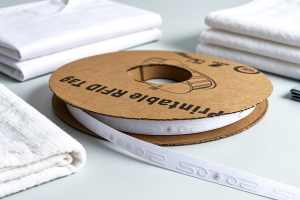
PPS (polyphenylene sulfide) RFID laundry tags are designed specifically for this environment. Encased in durable PPS material, these small button-shaped tags are sewn or heat-sealed directly into garments. Each tag contains a unique digital ID that can be read automatically by fixed or handheld readers—no line-of-sight required.
What makes PPS the material of choice for laundry tags?
Heat resistance: Withstands industrial washing at 90°C (194°F), pre-drying at 180°C (356°F), and ironing at up to 200°C (392°F).
Chemical resistance: Resists detergents, bleaches, softeners, and alkalis used in commercial laundry processes.
Pressure tolerance: Survives water extractor pressures up to 60 bars.
Durability: Rated for more than 200 industrial wash cycles.
Data retention: Maintains data integrity for up to 20 years.
The tags are small enough to be sewn into a seam or collar, and they can be customized in various sizes and colors. Once attached, they become a permanent part of the garment—invisible to the wearer but always readable
How RFID Transforms Uniform Rental
When every garment carries a unique RFID identity, the entire operation changes.
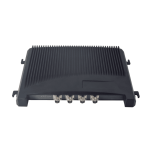
Real-time inventory visibility. Instead of guessing what’s in the wash, what’s on the truck, and what’s sitting in a customer’s locker, managers can see it all on a screen. Fixed readers at intake, sorting, washing, and dispatch points log every item automatically. Handheld readers allow staff to verify inventory on the spot.
Dramatic loss reduction. RFID tracking cuts typical loss rates from 10–15% to under 3%. When every garment is tracked individually, misplaced items are far easier to locate. And when items do go missing, the system provides a clear audit trail.
Labor savings. Manual sorting and counting are among the biggest bottlenecks in uniform rental operations. RFID automates these tasks, reducing the number of operators needed per shift and freeing up staff for higher-value work.
Accurate billing and fewer disputes. With item-level tracking, invoices are based on actual data rather than estimates. Customers can see exactly what they’ve received and what they’ve returned. Disputes decrease, and trust increases.
Extended garment life. The system records wash counts and care history for every item. When a garment reaches the end of its useful life, the system flags it for replacement. This data-driven approach helps providers optimize replacement cycles and reduce waste.
Per-wearer traceability. In healthcare and other regulated industries, knowing who wore which uniform and when is critical. RFID enables this level of traceability, supporting compliance with hygiene and safety standards
A Technology That's Proven at Scale
RFID laundry tags are not experimental. They’ve been deployed in thousands of uniform rental operations worldwide. A European textile rental company integrated 200,000 RFID tags into its towel and uniform inventory, achieving 99.5% inventory accuracy and a 70% reduction in labor costs for sorting. Hospitals across Europe are adopting RFID-enabled smart cabinets and room-based systems to manage scrubs and workwear more efficiently.
The return on investment is measurable. One analysis found that while a PPS tag may cost more upfront than a traditional textile tag, its survival rate is significantly higher and the labor savings alone far outweigh the tag cost. For most uniform rental providers, the system pays for itself within the first year of operation

The Bottom Line
Uniform rental is a high-volume, high-stakes business. Every lost garment costs money. Every billing dispute strains customer relationships. Every hour spent on manual sorting is an hour not spent on service.
PPS RFID laundry tags offer a practical, proven solution. They survive the heat, the pressure, and the chemicals. They automate inventory counts. They provide real-time visibility into every garment’s location and history. And they deliver measurable returns on investment.
The technology works. The question is whether your operation is ready to put it to work.